
Skip to content

Blogging for Dummies

Blogging for Dummies published on No Comments on Blogging for Dummies

(cartoon also posted on Blogworld)

The debate over whether CEOs and other prominent folks should hire ghostwriters to blog for them is a thorny one.

On the one hand, blogging culture is conversational and personal; we assume we’re having a discussion with the real person, and not with an intermediary.

On the other hand, intermediaries are the rule, not the exception, when it comes to VIPs on nearly every other communications channel. Op-ed pieces and letters to the editor that bear their names are usually drafted by PR or legal departments. Underlings draft correspondence for senior executives, and then run it through signature machines (which, incidentally, are amazing to watch in action, in a steampunk kind of way). Speechwriters – you get the picture.

I suspect that if they could get away with it, a lot of executives would delegate things like quarterly earnings conference calls. (“You! Yeah, you – the guy who was imitating Steve Ballmer at last year’s Christmas party. How’d you like to try doing that again?”)

Back on that first hand, though, is the argument that blogs and other social media aren’t just any business communications channel. They’re personal. And if you want to build a relationship of trust, then you’ll need a level of both personal connection and transparency.

Which is why I think there’s a lot to say for Shel Holtz’s suggested compromise (which he wrote as someone who opposes ghost-written blogs, but acknowledges they may be inevitable):

And if a business leader ultimately does opt to have someone else handle the writing of the blog, he should disclose it. What’s the harm in a statement like this on an executive blog: “Welcome to my blog. Several times each week, I articulate my thoughts to Mary Jones, who runs communications for the company, and she posts them here ensuring that I make the points I want to make. But rest assured, while Mary makes me sound better, the messages you read are mine; they come from my heart and I read all the comments myself.”

Maybe we’ll start hearing the same thing in other channels. Such as speeches: “Before I begin, in the interests of full disclosure, I talked to my director of communications for about four minutes about this speech, and the broad structure. I understand it went through eighteen revisions, twelve of them pointless, although I had an opportunity for input in only two, and in each case, the draft sat on my desk untouched for three days. A complete list of the nearly two hundred people who drafted, edited, altered or redacted portions of this speech is available on our web site.

“I was supposed to read it on my flight over, but the inflight movie was Iron Man 2, and I got sucked into it. I couldn’t read it in the cab, because I get motion sick, and I fell asleep in my hotel room last night just before I was going to read it over. Therefore, like you, I can’t wait to find out what I’m about to say.”

Get 100,000 Canadians to opt out of the Yellow Pages

Get 100,000 Canadians to opt out of the Yellow Pages published on 6 Comments on Get 100,000 Canadians to opt out of the Yellow Pages

(teacher at a museum) And right here, children, is a 21st-century artifact called the Yellow Pages.

I drew this on my iPhone – it’s the first cartoon I’ve drawn there (although I had to resort to the laptop to add the caption – graphic app developers, please consider adding text support, ‘kay?) and I did it with Autodesk SketchBook Mobile for the iPhone and the Logiix StylusPro, a worthy competitor to the Pogo Sketch stylus I’ve been using until now.

I didn’t spend a lot of time trying to make it look pretty; what you’re seeing is the first take, and took me maybe four minutes to draw. So the iPhone turns out to be perfectly viable for quick sketches.

It’s in support of David EavesFacebook Group aimed at getting 100,000 Canadians to opt out of receiving those tree-killing, energy-burning, shelf-space-taking-up tomes known as the Yellow Pages. Here’s my blog post on the topic.

Full <body>’d

Full <body>’d published on 2 Comments on Full <body>’d

Every once in a while, I come across an older cartoon that never made it to the new site. Here’s one, from those halcyon days of November 2009, back when I was a younger, more carefree man, guzzling coffee and, indeed, taking it #000000. (Although, to speed up the line at Blenz, I’d always order it #000.)

Is there a mug? Of course there’s a mug:

Enhanced by Zemanta

The forbidden dance

The forbidden dance published on No Comments on The forbidden dance

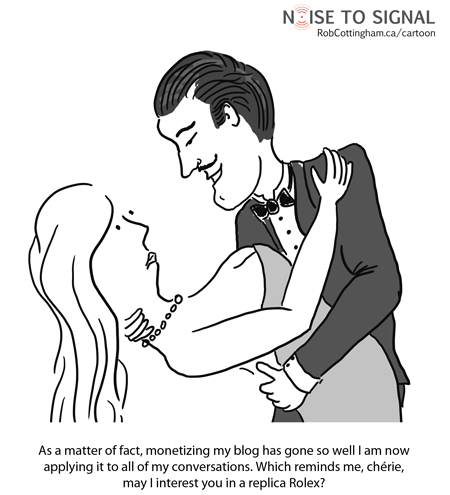
Hey, I get it. A lot of people would like to make money from blogging. I wouldn’t mind it, either. (Hence the Google ads on RobCottingham.ca, which so far have earned me a total of… um… excuse me, I have to go cry silently in a dark corner.)

But I’ve met enough people whose level of single-mindedness around monetizing their blogs worries me – for their sakes and their readers’. On the blogs I read and love – including the ones that make a lot of cash – what shines through is the writer’s passion for the subject matter, and for connecting with their audience.

Passion for making money? That’s a distant third at best. (Unless the blog itself is about making money and is still powerfully written and passionate, in which case you’re John Chow.) The blogs that are concerned first and foremost with driving eyeballs and flogging clickthroughs all seem to me to be dead, soulless places.

There’s joy to be had in this business, right alongside analytics and conversion rates. I can’t speak for anyone else, but I know it’s my bottom line. And once we start commoditizing our relationships and conversations, we’ve given up something very precious.

By the way, my wonderful wife and partner Alexandra Samuel had a great post on something similar a few days ago. Do have a look!

Beyond free diapers

Beyond free diapers published on 3 Comments on Beyond free diapers

The conversation about conflict of interest for bloggers (and other social media types) never really dies down, and flares up constantly in ways large and small.

Sometimes it’s something as major as the U.S. Federal Trade Commission going after blogger freebies. Sometimes it’s just a drive-by accusation that a blog post is “link bait”, and not a useful or genuine contribution to the conversation.

The common thread is this: What responsibility we have to our audiences, when are our own interests in conflict with theirs, and what do we do when that happens?

Transparency is one answer. Disclose your interest, and all – hopefully – will be forgiven. (Jeannine Schafer drew some great disclosure notifications on LouisGray.com.)

And a little reader due-diligence doesn’t hurt, either. Knowing that a blogger is a political activist, or a real estate agent, or a (ahem) social media strategist means you can assess what you’re reading with some knowledge of their agenda. (Even the most well-intentioned among us writes with part of our mind attuned to the potential impact on things we value – whether it’s a social cause, our social standing, or a business bottom line.)

Still, I like to suspend my skepticism once in a while. Because one of the things that makes social media so valuable is the chance to connect with genuine human beings, expressing themselves in ways that aren’t the result of careful calculations of strategic interests, sales trajectories, keyword analysis or free samples of probiotic yogurt drinks.

And digging for that conflict of interest, while it may protect me from being taken for a ride, also means approaching social interactions with a degree of suspicion… which is a shaky start to a new relationship.

Yes, maybe a blogger’s angling for trinkets or traffic. But maybe they’re expressing a deeply-held passion. And maybe it’s a little of both. Somewhere, there has to be a balance between the benefit of the doubt and a healthy skepticism.

What’s that on its wing? …A little “AddThis” button!

What’s that on its wing? …A little “AddThis” button! published on No Comments on What’s that on its wing? …A little “AddThis” button!

You can thank the nice people at Ragan Communications for this rare Friday update – they’ve had me guest-blogging a few cartoons for their Social Media for Financial Communicators Summit at NASDAQ.

Hope everyone has a great weekend. Sunday’s cartoon on ReadWriteWeb involves a stealth fighter. Really.

Also, every flowchart ends with a reference to “meddling kids”

Also, every flowchart ends with a reference to “meddling kids” published on 2 Comments on Also, every flowchart ends with a reference to “meddling kids”

From my sketchbook: one of the few cartoons I’m drawing on paper these days.

Speaking of paper, want to do the world some good? If you live in Canada, check out David Eaves’ new Facebook group, aimed at convincing 100,000 Canadians to opt out of receiving the Yellow Pages: those massive tree-killing, energy-sucking tomes of advertising that land with a thud on your doorstep every year, even though you never asked for them. (Dave’s blog post explaining why tree-killing and energy-sucking is a bad thing is here.)

The eternal mystery

The eternal mystery published on 1 Comment on The eternal mystery

You know what would bring those kids running, don’t you? A Facebook page.

Before you know it, “booking your revenue when it’s earned” will become the new “keepin’ it real”. You’re welcome.

A is for audience

A is for audience published on 1 Comment on A is for audience

Or the people formerly known as the audience, anyway.

Some news: in the run-up to BlogWorld and New Media Expo 2010, I’ll be cartoon-blogging on their site (and at the event itself). This is the first cartoon there – do drop by and let them know if you like it!

Oh, and one more thing… this is cartoon number 300. Everyone gets the day off to celebrate.

Ernst Stavro Blofeld would like to be your friend

Ernst Stavro Blofeld would like to be your friend published on 5 Comments on Ernst Stavro Blofeld would like to be your friend

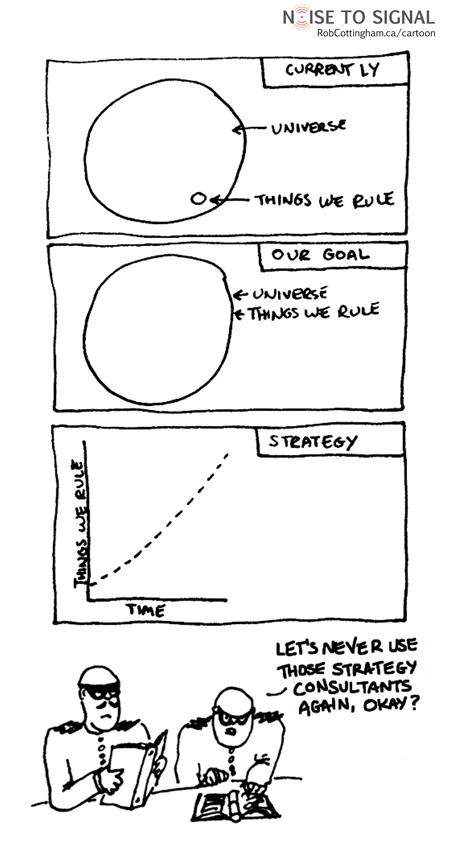
Metrics. They’re so tempting to chase, because you can so easily see your progress: this many Likes. This many friends. This many retweets. This many uniques.

But very few metrics have ultimate meaning; they’re mostly means to an end. Maybe that end is profit. Maybe it’s social change. Maybe it’s finding love in an uncertain world. (And for the record, “two hearts beating as one” is too a measurable outcome.)

Don’t just obsess about metrics. Interrogate them. Skeptically. “Yeah? So what?” is a solid opening question. Once you get that answer, so is “Since when?” Sometimes “Says who?” isn’t a bad one either.

Otherwise, we end up chasing metrics instead of goals. We follow tactics instead of strategy. And instead of focusing on that one thing we truly want to achieve, we settle for being a hundred people’s ninth favourite thing.


I will grasp at any straw, no matter how thin, to do a Bond cartoon. This probably wasn’t my most technically proficient cartoon ever… but it was fun as hell to draw.

And isn’t that what really counts?

And isn’t that what really counts? published on No Comments on And isn’t that what really counts?

Just a sec… I’m tabulating the amount of time spent drawing, the wear and tear on the graphics tablet, depreciation on my knuckles…

…and applying an approximate financial income equivalent to retweets, comments, pageviews, trackbacks and Likes…

…wahoo! Profit!

Just venting

Just venting published on 3 Comments on Just venting

By the time you read this today, the BP/Transocean/Halliburton oil hemorrhage may finally be on its way to a resolution. Or it may still be burbling away, happily coating wildlife, habitat and the region’s tourism and fishing industries with a viscous sheen of Game Over.

A lot of us have taken to our networks to fulminate over this without a lot of focus or hope of affecting things – me included. Of course, sometimes you just have to vent (as a certain large, gaping opening in a BP oil pipe could tell you). And raising awareness is a Good Thing.

But some folks are taking it beyond just a few retweets, and using online tools to genuinely contribute to our understanding of the disaster. Take Paul Rademacher’s use of Google Earth to map the extent of the oil spill onto any location on Earth – say, your own hometown – and gain a sense of the geographical scope of the situation. (It’s possible, in turn, because of Google’s impressive crisis response page for the spill, which has a collection of mapping layers and resources.)

Or look at Oil Reporter, an open-source app for the iPhone and Android that lets ordinary people log individual instances of oil spill impacts they discover – crowdsourcing the documentation of the spill’s effects, Ushahidi-style. It’s created by the good people at CrisisCommons, which has partnered with the San Diego State University Visualization Center to manage the data collected through the app – which is available through an open API.

That hasn’t meant one less drop of oil has come out of that pipe. But these two initiatives, and others like them, can help buttress support for spending the billions that will be needed to do what can be done to clean up the aftermath, and in the case of Oil Reporter, help point out places some of those resources should go.

And with any luck, it could spur some people like me who’ve confined our activism to subscribing to the BPGlobalPR Twitter feed (which is often funny as all hell) to do something a little more meaningful.

By the way, not to knock hashtags: there have been some great awareness-raising campaigns based around them, events have made marvellous use of them, and I love the way they bring conversations together.

And you thought hunger was the best sauce

And you thought hunger was the best sauce published on 2 Comments on And you thought hunger was the best sauce

I have this draft restaurant review in my head that goes something like this:

“The hot new restaurant in town is Air Canada Flight 166, but for the life of me, I can’t understand what the fuss is about. The seating is cramped, intrusive video advertisements play at the beginning of the meal – which is indifferent at best – and, most baffling of all, when I left the restaurant, I was 2,600 kilometres from where I’d parked.”

And yep, another iPad cartoon – this one in fact drawn on a plane, on my way to lead a workshop on social media at Persuading to Win 3 in Ottawa. As much as I loved meeting my fellow presenters George Lakoff and Marc Zwelling, this is the kind of conference where at least half the enjoyment lies in seeing old faces. I got to see agenda-mates Elaine Bernard and Sean Moffitt only in passing, and a few other familiar folks from my Toronto and Ottawa days… but the greatest pleasure was spending even a few minutes with Ish Theilheimer and Kathy Eisner. Ish gave me my first full-time job out of university, and he’s been both a mentor and – along with Kathy – a good friend ever since.